
Case Studies
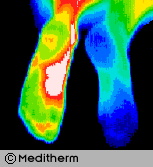
A patient presented with Complex Regional Pain Syndrome (CRPS) affecting the right foot, characterized by a significant increase in sympathetic motor tone. Thermographic imaging revealed the right foot to be 3.7°C colder than the left — a substantial thermal asymmetry strongly indicative of sympathetic dysfunction. A cold stress test was also performed and yielded a positive finding, demonstrating no significant sympathetic change, which further supported the presence of abnormal autonomic regulation.
The CRPS developed following a fractured calcaneus sustained approximately 18 months earlier. Although the fracture had healed structurally, the patient continued to experience persistent pain, swelling, hypersensitivity, and difficulty bearing weight on the affected foot. Walking and prolonged standing were especially painful, limiting mobility and daily functioning. Despite these symptoms, the diagnosis of CRPS was initially missed because nuclear imaging results did not display the patterns typically associated with the condition. This delay led to prolonged suffering and contributed to the chronicity of the patient’s pain.
Thermography played an important role in clarifying the diagnosis by objectively demonstrating sympathetic dysfunction, temperature asymmetry, and impaired autonomic response — all hallmark findings in CRPS. The case highlights a critical point: some presentations of CRPS can mimic psychological or functional pain disorders, and patients are sometimes misdiagnosed as having psychogenic or hysterical pain states when structural tests appear normal. This misinterpretation can delay appropriate treatment and worsen long-term outcomes.
By offering clear physiologic evidence of abnormal sympathetic activity, thermography provides valuable diagnostic support, helping ensure that CRPS is recognized and treated promptly rather than dismissed or misunderstood. Thermography is able to show characteristic changes if utilised.
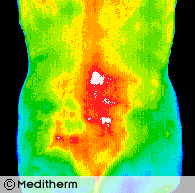
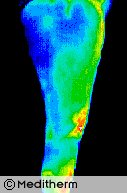
A 32-year-old housewife and mother presented with acute, debilitating back pain that radiated into the right side of her lower body. Her symptoms included significant sensory changes and noticeable motor weakness corresponding to the L2 and L3 nerve root distribution. She reported difficulty bending, lifting her leg, and performing routine daily tasks due to sharp, shooting pain accompanied by numbness and tingling. These neurologic findings suggested possible nerve root compression, but the severity and pattern warranted further investigation.
Thermographic imaging was performed as part of her initial assessment, revealing a clear thermal asymmetry along the right L2/L3 dermatome. This pattern — consistent with inflammation and nerve irritation — strongly supported the suspicion of right-sided nerve root involvement. The thermal findings helped localize the problem early and provided physiologic evidence of active nerve irritation.
Subsequent structural imaging, including myelography and CT scanning, confirmed the clinical and thermographic impressions. Testing showed a large right-sided L2/L3 disc prolapse exerting pressure not only on the L2 and L3 nerve roots but also extending downward enough to involve the L4/L5 root pathway. This explained the patient’s combination of symptoms, including both high lumbar pain and radiating discomfort affecting multiple levels.
Together, the thermographic and structural findings offered a comprehensive picture of her condition, guiding appropriate treatment planning and helping monitor her progress over time.
Thermography shows excellent correlation with CT, MRI and Myelography in radiculopathy.
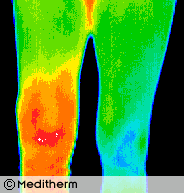
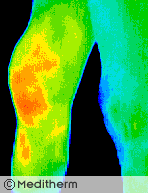
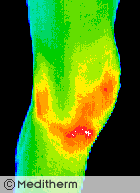
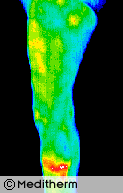
Following a right knee surgery, the patient entered the early postoperative period with an unexpectedly painful and rapidly developing effusion. The knee became swollen, warm, and increasingly difficult to bend, causing significant discomfort with even minimal movement. Given the possibility of infection, excessive inflammation, or postoperative complications such as hemarthrosis, further evaluation was necessary to determine the underlying cause of the swelling.
Thermographic imaging was performed to assess the inflammatory status of the joint. The scan revealed a pronounced thermal increase over the right knee, clearly indicating an active inflammatory reaction consistent with postoperative irritation or bleeding within the joint space. This physiologic information supported the clinical impression that the effusion was more than routine postoperative swelling and warranted immediate intervention.
To relieve pressure, improve mobility, and clarify the nature of the effusion, the knee was aspirated. Approximately 30cc of blood-stained fluid was withdrawn from the joint. The appearance of the aspirated fluid confirmed that the swelling was due to postoperative hemarthrosis — bleeding into the joint — rather than infection or simple fluid accumulation.
The combined use of thermography and aspiration allowed for swift identification of the issue and timely treatment, helping reduce the patient’s pain, prevent further complications, and support a smoother recovery process.
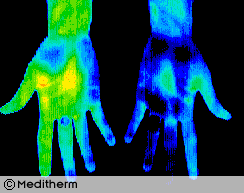
Post-Traumatic Complex Regional Pain Syndrome.
A 34-year-old female supermarket worker presented with a long-standing left wrist injury sustained three years earlier. Since the initial trauma, she had developed classic features of Complex Regional Pain Syndrome (CRPS), including severe, persistent pain; hypersensitivity; and noticeable color and temperature changes affecting the left wrist and hand. Daily activities became increasingly difficult, and even light touch triggered significant discomfort. The marked thermal asymmetry between her affected and unaffected limbs suggested ongoing sympathetic dysfunction.
She initially experienced meaningful improvement following a right cervical sympathectomy, with reductions in pain intensity and normalization of temperature in the affected hand. However, approximately one year later, her symptoms gradually returned, prompting further evaluation and alternative treatment options. Intravenous Guanethidine was administered as a sympathetic blockade, resulting in partial but measurable relief. Thermographic imaging documented a substantial reduction in the temperature differential — decreasing from a pre-treatment delta T of 6.2°C to just 0.8°C post-treatment — demonstrating a significant physiological response.
These findings highlight the value of thermography in CRPS management. By providing objective visual data before and after sympathetic blockade, thermography helps quantify treatment effectiveness, guide clinical decision-making, and monitor the progression or recurrence of symptoms over time. Its ability to document subtle autonomic changes makes it a valuable adjunct in evaluating therapeutic interventions for sympathetically maintained pain.
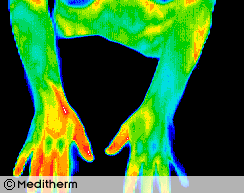
The EMG was normal but the left median sensory nerve latency and amplitude suggested minimal dysfunction relative to the right side. Thermography during sympathetic challenge (cold stress test) showed sympathetic nerve dysfunction consistent with an early left carpal tunnel syndrome.
Thermographic sensitivity for detection of early carpal tunnel syndrome is improved by cold stressing both hands. Sympathetic nerve fibres in the symptomatic median nerve are hyperirritable producing a sustained response during cold stress.
Frequently Asked Questions
- How should I interpret changes in temperature — what magnitude of difference is considered meaningful in a thermographic scan?
- Can thermography be used to monitor progress of treatment or recovery, and how frequently should it be repeated?
- Are there any limitations to what thermography can detect — conditions or anatomical regions where it’s less reliable or should be used in conjunction with other tests?
Q1. How should I interpret changes in temperature — what magnitude of difference is considered meaningful in a thermographic scan?
Answer: While the case studies show examples of significant temperature differentials (for example a 3.7 °C colder foot in a CRPS case), each body region and condition has unique “normal” variation. A small difference (e.g., 0.5-1 °C) may not always be clinically significant; what matters is how the change is associated with symptoms, baseline scans, symmetry, and whether it changes over time. In follow-up scans, even modest shifts in temperature patterns or symmetry can be meaningful if they align with other clinical findings or improvements/worsening of symptoms.
Q2. Can thermography be used to monitor progress of treatment or recovery, and how frequently should it be repeated?
Yes — one of the case studies shows how temperature differentials improved from a delta T of 6.2 °C to 0.8 °C after treatment for CRPS. Thermographic imaging is therefore valuable not only for diagnosis but for objectively tracking changes over time. The ideal frequency depends on the condition and treatment plan: for acute injuries you might scan every few weeks, for chronic conditions maybe every 3-6 months. Always coordinate with your clinician to align imaging with meaningful clinical milestones rather than arbitrary intervals.
Q3. Are there any limitations to what thermography can detect — conditions or anatomical regions where it’s less reliable or should be used in conjunction with other tests?
Absolutely. While the case studies illustrate strong correlations with conditions like nerve root irritation, synovitis, and early carpal tunnel syndrome, thermography is not a standalone diagnostic tool for all conditions. It primarily reflects thermal or sympathetic nervous system changes (temperature and vascular responses) rather than purely structural alterations. For example, if a condition has no significant thermal/vascular change, the scan may appear “normal” even if there’s still disease. In those cases, imaging like MRI, CT, or conventional clinical testing should be used in combination. Patients should view thermography as a powerful complement — not a complete substitute — to standard diagnostics.
